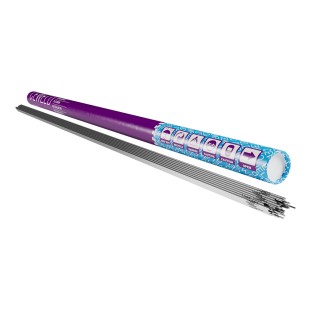
Lincoln LNT NiCroMo 59/23
Applications of NiCrMo 59 Tig in aggressively corrosive media include scrubbers for flue gas desulphurization (FGD), digesters and papermaking equipment, chemical process plants, corrosion resistant overlays and in severe offshore and petrochemical environments.
Applications of NiCrMo 59 Tig in aggressively corrosive media include scrubbers for flue gas desulphurization (FGD), digesters and papermaking equipment, chemical process plants, corrosion resistant overlays and in severe offshore and petrochemical environments.
CEWELD NiCrMo 59 weld deposit composition of 59%Ni-23%Cr-16%Mo is designed to match the nickel base corrosion resistant alloy commonly known as alloy 59. The high level of Mo is similar to alloys C276 and C4 but performance in a wide range of more oxidizing media is significantly enhanced by increasing Cr to 23% in alloy 59. Total alloying exceeds the level typically present in alloy C22; it is therefore considered suitable for welding this group of alloys. Alloy 59 consumables also provide strong, tough Nb-free weld metal for dissimilar welds in Superaustenitic and Superduplex stainless steels or combinations of these with nickel base alloys. Some authorities do not allow or have discontinued use of 625 type consumables for such applications, where deleterious Nb-rich precipitates may form in diluted or partially mixed regions around the fusion boundary. Alloy C276 is possibly a more economic alternative depending on the required properties in this situation.
NiCr23Mo16Al, NiCr21Mo14W, NiCr23Mo16Al, NiMo16Cr15Ti, NiMo16Cr15W, NiMo16Cr16Ti, X2CrNiMnMoN 17-12-2, NiCr26MoW
2.4608, 2.4605, 2.4602, 2.4610, 2.4819, 2.4692, 1.4562, 1.4563, 1.4529, 1.4539, 1.4404
Duplex, Super-Duplex and Super-Austenitic Stainless steels,
Nickel alloys such as UNS N06059 and N06022, INCONEL alloy C4, C-276, and INCONEL alloys 622, C22, 625, and 686 CPT, Alloy 31, Alloy 59, Alloy 33


| Heat Treatment |
RP0,2 (MPa) |
Rm (MPa) |
A5 (%) |
Impact Energy (J) ISO-V | Hardness | |
|---|---|---|---|---|---|---|
| -196°C | RT | |||||
| As Welded | 450 | 720 | 35 | 70 | 100 | HRc |
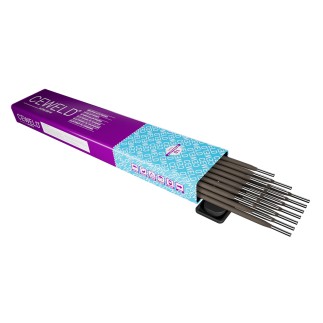
CEWELD NiCrMo 686 CPT
Is an equivalent for Lincoln LNT NiCroMo 59/23
CEWELD® NiCrMo 686 CPT is particularly valuable in operating environments where general corrosion resistance and resistance to hydrochloric acid or sulfuric acid, crevice corrosion in hot, concentrated acid chloride solutions, NaCl solutions saturated with sulfur dioxide, and oxidizing chloride solutions are required. In addition, it is resistant to intergranular corrosion and sensitization-induced intergranular corrosion in highly oxidizing environments.
CEWELD® NiCrMo 686 CPT is also suitable for overlay welding of alloys of types 625, C276, C4, C22, and 59, as well as for welding super duplex and super austenitic steels.
Applications include the chemical and petrochemical industries, the application of corrosion-resistant coatings and valve seat inserts, and flue gas desulfurization plants. Properties: CEWELD® E NiCrMo 686 CPT weld metal is exceptionally resistant to pitting corrosion.
CEWELD® NiCrMo 686 CPT is particularly valuable in operating environments where general corrosion resistance and resistance to hydrochloric acid or sulfuric acid, crevice corrosion in hot, concentrated acid chloride solutions, NaCl solutions saturated with sulfur dioxide, and oxidizing chloride solutions are required. In addition, it is resistant to intergranular corrosion and sensitization-induced intergranular corrosion in highly oxidizing environments.
CEWELD® NiCrMo 686 CPT is also suitable for overlay welding of alloys of types 625, C276, C4, C22, and 59, as well as for welding super duplex and super austenitic steels.
Applications include the chemical and petrochemical industries, the application of corrosion-resistant coatings and valve seat inserts, and flue gas desulfurization plants. Properties: CEWELD® E NiCrMo 686 CPT weld metal is exceptionally resistant to pitting corrosion.
CEWELD® NiCrMo 686 CPT is a single-phase, austenitic Ni-Cr-Mo-W alloy with excellent corrosion resistance. Its high nickel (Ni) and molybdenum (Mo) content ensures good resistance under reducing conditions, while the high chromium (Cr) content provides resistance to oxidizing media. Molybdenum and tungsten contribute to resistance to localized corrosion, such as pitting. The iron (Fe) content is carefully controlled to optimize properties. A low carbon content helps to minimize precipitation at grain boundaries, thereby maintaining corrosion resistance in the heat-affected zones of welded joints.
It is important to maintain a maximum heat input of 1.5 kJ/mm and a maximum intermediate temperature of 100 °C.
ENiCrMo-14, E Ni 6686 NiCr21Mo16W4
2.4602, 2.4605, 2.4606, 2.4607, 2.4610, 2.4819, 2.4656, 1.4529,1.4547, 1.4565
NiCr23Mo16, NICr23Mo16Al, NiCr21Mo16W, NiMo16Cr15Ti, NiMo16Cr16Ti, NiCr21Mo14W, NiMo16Cr15W, NiCr22Mo9Nb, Alloy 59, Alloy C4, Alloy 276, X1NiCrMoCuN25-20-7, X1CrNiMoCuN20-18-7
ASTM: C-4, C-276, C-22, 625, 904hMo
UNS: N06059, N06455, N10276, N06625, N08925, S31254,N06686, N06022, N06059, N06200, N08367, NO8926, NO8031
Duplex, Superduplex, super austenitic stainless steel, Nickel Alloys, N06059, N06022, Hastelloy C276, Alloy C22, Alloy 59. Inconel 622, 625, 686, Outokumpu 654 SMO, Incoloy® Alloy 25-6MO, 27-7MO (Special Metals)
| Heat Treatment |
RP0,2 (MPa) |
Rm (MPa) |
A5 (%) |
Impact Energy (J) ISO-V | Hardness | |
|---|---|---|---|---|---|---|
| RT | -196°C | |||||
| As Welded | 450 | 760 | 40 | 100 | 80 | HRc |